Twenty-eight Issei men were arrested from Lompoc, CA1 after Japan bombed Pearl Harbor in December 1941. My father, Masazo Furuya, was one of them.
Lompoc is a city about halfway between Santa Barbara and Morro Bay. Before it was Lompoc, it was lompo’o, Lompoco, and then Rancho Lompoc, reflecting its Chumash, Spanish, and Mexican heritage. In 1941 my father was a foreman for the Guadalupe Produce Company, a Japanese-owned farm founded in 1923 by Setsuo Aratani, an Issei from Hiroshima.1
When he was arrested, my father was 40 years old; he had a wife (Yoneko) and four children: me (Ritsuko, almost 5); Mikio (3.5); Seiji (2); and Naoko (three months). When the Issei men from Lompoc were taken away, no one knew why or where they had been taken.
What I remember most vividly: when the FBI came to arrest my father, they handcuffed him. As they were taking him from the house, my little brother Mikio wrapped his arms around the FBI agent’s leg to try to stop him from taking our father away.
Without my father, my mother had to face the forced removal alone. She asked friends for help and was advised to escape California before everyone was put into camps. So, with the brand-new car that the family had purchased just before the War started, she packed up her four children and joined a group led by Fred Wada, a produce dealer from Oakland. This group formed a cooperative farming colony, Keetley Farms, on land leased in Utah, and was determined to avoid the camps by making a go of it by raising produce.
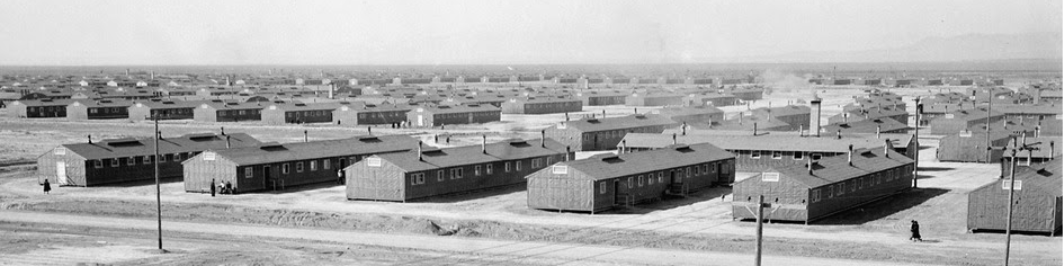
But my mother found the conditions in Keetley to be “terrible”; the family’s housing was “a shack.” So in September of 1942, our family entered Topaz Relocation Center in Utah.
Meanwhile, we had learned that my father was imprisoned in a Department of Justice internment camp at Ft. Lincoln in Bismarck, North Dakota. He was later transferred to Lordsburg, New Mexico. When the U.S. Army decided to recruit Japanese Americans from the camps, they issued the infamous “loyalty questionnaire,” which was supposed to determine whether individuals were loyal to the United States or Japan.

My father was angered by it, and wanted to answer “no” and “no” to Questions 27 and 282—but my mother persuaded him to answer “yes-yes,” as she wanted to remain in the U.S. after the War.

In July 1943, my father was released and joined us in Topaz. It had been almost a year and a half since we had seen him. My brother Mikio and I remembered him; but my younger siblings didn’t, and they ran away when he tried to approach them.
1 McReynolds, John V. Vanished: Lompoc’s Japanese. Press Box Productions, 2010.
2 Question 27:
Part of the questionnaire devised by the government to determine loyalty, this question asked if subjects were willing to serve in the armed forces of the United States on combat duty. Those who were old or incapacitated, or who were angry with the government for violating their civil rights, often answered “No.”
Question 28:
This question asked if subjects would renounce loyalty to the Emperor of Japan. Some who never had loyalty to the Emperor felt that answering “Yes” would imply that they had held such loyalty to begin with. First-generation Issei, ineligible to become American citizens, worried that renouncing loyalty to the Emperor would make them stateless persons. Those who responded “No-No” to questions 27 and 28 became known as “No-No Boys,” which was a term that became synonymous with “disloyals” or “troublemakers.” Now, more than 80 years later, “No-No Boys” are generally viewed as legitimate resisters to an unjust incarceration.
For more information about Keetley:
Keetley Farms
442: How a Group of Japanese Americans Avoided Incarceration During WWII
The Japanese Agricultural Colony at Keetley, Wasatch County
About the contributor: Ritsuko Furuya was born in Lompoc, CA in 1937. Her father was one of 28 Issei men from Lompoc who were arrested after Pearl Harbor and incarcerated at Ft. Lincoln in Bismarck, ND. He rejoined the family in July 1943 in Topaz. After the War, the Furuya family resettled in San Mateo, as Lompoc did not welcome Japanese Americans back. Ritsuko is retired from her career as an administrator of hospital laboratories, and currently lives in Belmont, CA.
© 2025, Ritsuko Furuya. All rights reserved.
To Risuko…I remember our days working together at Peninsula Hospital. You made mention your frost bite from camp in Utah.
What that war did to our families!
Mine was a different story maybe I never told you. My father was killed WWII in Europe, leaving my mother a widow with 2 young daughters. With a large extended family we made it through some tough years.
Fast forward to both of us surviving and working at Peninsula Hospital.
Rachel Maddow’s recent Burn Order brought back these memories. Hope this message reaches you. I would love to hear from you.