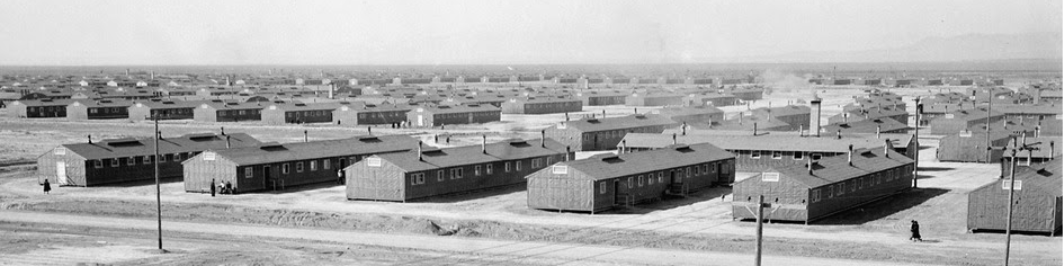
Meanwhile, my mother, brother and I remained in Tule Lake. Hiroshi was on the Block 69 baseball team–its youngest member.


Being separated from his family was hard on my father. He regretted that he could not be with us, to watch Hiroshi play baseball. He spent many hours in the woodworking factory at Ft. Lincoln and made pencil boxes for us–one decorated with a little girl and a puppy for me, and another with a little boy in a baseball uniform, holding a ball and bat, for Hiroshi. The camp also showed Hollywood movies every night, offering prisoners a brief escape.
We did not see my father again until we were reunited on board the USS Gordon in late December 1945, having elected to repatriate to Japan.
Back in Fukuoka, we joined my grandparents; my bilingual dad was recruited by the Occupation Forces as an interpreter. He had lost over two years with us–I was six, my brother Hiroshi almost nine–before he could finally play “catch” with his son.
I adjusted easily to first grade; but for Hiroshi, the transition was more difficult. His language, his clothes, his manner, all marked him as “different,” and he had a hard time making friends. His father was one of the only people he could talk to.
Then, just five months after our return to Japan, tragedy struck. While running to meet his father at the station, Hiroshi was killed in an accident as he jumped down from a delivery wagon. His clothing got caught in the wheel and he was pulled underneath and crushed. It devastated my parents. My mother was never the same. For my father, Hiroshi’s death became his one deep regret about returning to Japan.
After the Occupation was dissolved in a year, my father’s American boss introduced him to a company that distributed American films—a rare and valuable entertainment resource in postwar Japan. My dad became a general manager.