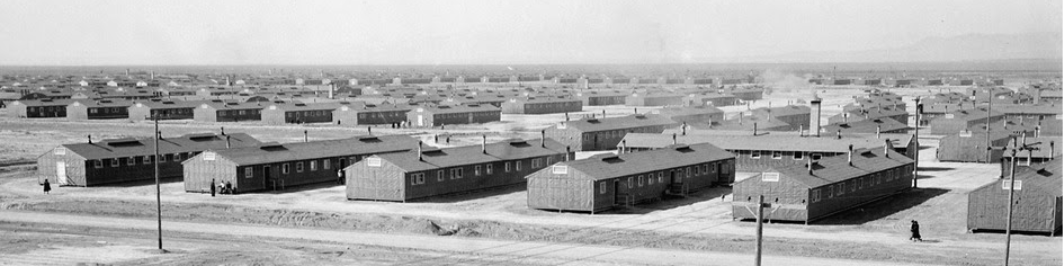
Page 2
Forlornness and sadness reign deep in my heart, and
As I lay sick in the abode not of my choosing,
My memories go back to the peace of yester years.
People, mountains, and rivers I once knew
Kept reminding me of the happier bygone days.

The camp was now rampant with ugly rumors;
Some were patriots true to their hearts,
Some were rabble-rousers stirring discontent.
The camp was split between loyals and those who were not;
The problem of segregation became the center of storm.

The mass of residents unable to side,
Behaved like beer froth, now here, now gone.
With everyone suffering from war-weary heart,
Something had to happen to give hope and life.

A timely thing did happen in the life of the camp;
A community council was called to convene
To discuss and decide on our own self rule.

The community council now took active role
To bring civilization to the desolate land.
Infirmary, school, and roads were built
Despite the wage of sixteen [dollars] a month.

The people’s mind turned to cultural pursuits,
To the mountains they trekked in search of seedling trees
And found the regions rich to the delight of every one
In shapely shells, fossilized stones, and ancient arrowheads.
Plants thrived and bloomed in tenderly cared gardens;
Carps began to swim in the front yard ponds.
Golden vesture of autumn fields delighted the hearts
Of those saddened by war.
Now suddenly rose the pursuit of arts;
Painting, calligraphy, theatrical arts,
Rokyoku, shigin, goh and shogi games.
Some preferred to sing rokyoku to delight themselves.
[Note: Rokyoku is traditional Japanese narrative singing; shigin is the recitation or singing of Japanese poetry; goh is a strategy board game; shogi is Japanese chess.]

The stars twinkled around the arched new moon;
The cold night wind felt deep in the bones;
Only the dreams broke the quietness of the moonlit camp.

The gallant heroes of Combat Regiment 442nd,
Fighting in the war fronts of Italy and France,
Countless telegrams received at homes,
Telling of the sacrifices made in love of their country,
Funerals were held at this and that home,
Sutras were chanted and incense burned,
Some sobbed and prayed before the cross of God.

The once abandoned land, land now rich with blessings,
One big family separated from the world.

The wending year brought spring thrice in the camp, and
Now we were told of our return to the Coast.
Our hearts too deeply rooted in the Topaz soil, and
Once again joy, anger, and sadness filled our hearts.
But what the people nurtured in the cultural life
Continued to brighten everyone’s soul.

But now we would live in cities, a different world from now;
The time has come to say good-bye.
Adieu Topaz, may God bless you forever.
About the contributor: Henry Sadaji Sugaya emigrated to the U.S. from Chiba Prefecture in 1906. He worked as a farm laborer, a schoolboy, and an employee of Kitchener-Schmulian Co., a men’s clothing store in downtown SF. He and his wife Hatsu then worked as housekeepers (he as a cook, she as a maid) for a family in Burlingame, CA (later, Atherton) for 15 years until the forced removal. They were sent to Tanforan, then Topaz, where their son Hisashi was born in 1942. Henry was a cook and community council member in camp. The family returned to California in 1945, where Henry and Hatsu resumed working for their former employer. Henry passed away in 1986.
© 1978, Henry Sugaya, with slight edits by Hisashi Bill Sugaya. This poem was initially published in My Cultural Bequeath: the Comprehension of Art, by Henry Sadaji Sugaya. Japan Publications, Inc., 1978. All rights reserved.
Wow Bill! Thanks for sharing your father’s poem from camp! I’m so surprised to read this thoroughly appointed poem. He mentions everything about life at camp. I’m curious to ask you, did you just recently find this? Or, you had it all along?
I hope it gets read by everyone at the museum.
Hi Tracy – The poem is in my father’s book, which I’ve had for decades, but I never did anything with the contents. The book has been distributed to various libraries and JA organizations like the Topaz Museum (I finally went off the board in 2015) and JANM. I have other pages in English about Topaz from the book. I can send you those. Good to hear from you! -Bill