by Iso Umeki
(Part 2 of Iso Umeki’s memoir, “Voluntary Relocation, told of the Umekis’ attempt to escape camp by moving outside Military Area 1 to Del Rey, CA. However, it wasn’t long before the military exclusion zone was expanded, and they ended up being sent to Tanforan Assembly Center in San Bruno, CA. Part 3 continues the family’s story.)
We packed our meager belongings once again and were taken by Greyhound bus from Del Rey to Tanforan, near San Bruno. This was formerly a race track. At least, we were glad to be reunited with our brother Toshi and Harue, his wife. Our first day there, more than a half dozen people opened the door of our barrack and then excused themselves. We finally asked about these curious visitors and were told that a couple had moved out the night before because the lady had seen a ghost. The poor soul had lost her mind and had to be committed.
Our barrack was a temporary home, where grass was coming up through the shoddily built floors, where we walked a mile to the main dining area, where we stood in a long line, and by the time we finished and returned to our rooms, it was time to go back again.

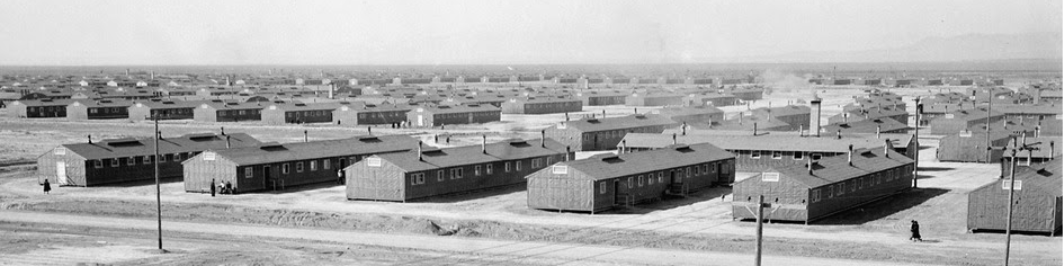
In October, we packed again. This time we were sent by train to a more permanent home, Topaz Relocation Center, located at the edge of the desert and 140 miles from Salt Lake City, Utah. The total population was about 8,780.
We were assigned to an empty room, complete with ceiling light, stove, and closet. This was one of six rooms in a barrack, ours being a larger size since there were five of us. The dining room, laundry, showers, and toilet facilities were separate buildings in each block. The weather contributed to the uncomfortableness. The summers were very hot and sticky while the winters were freezing cold.
It was windy much of the time, causing clouds of dust to seep through the doors and windows of our room. Those of us who worked found it necessary to cover our faces while traveling the short distance. We missed the beautiful weather in the Bay Area!
I found employment as a stenographer in the center Hospital and received $16 a month, plus $3.75 for clothing allowance. I eventually worked my way to the top pay scale of $19. This was the same rate paid to doctors who worked practically 24 hours a day!
The period in the camp was an education for many of us. We learned about attitudes of individuals and groups. Some were extremely bitter and condemned the United States for its actions against the Issei and Nisei. Still others remained silent and took each day as it came. I was in this group and you will soon learn why.
Although our two brothers were serving in the U.S. Army, one stationed in Japan, and one in Europe, we still had to wait until the FBI could check our attitudes and activities before we could be released. Not wishing to delay my hope for freedom and because I hoped to marry soon and live in Salt Lake City, I remained a quiet person.