The long drive to the new home on the outskirts of San Leandro took a full day (20 minutes by freeway today), and we were tired by the time we reached our destination. Yet, we shrieked with delight and forgot our weariness when we found our new home, surrounded by rolling hills and rows of apricot and cherry trees. What could be better than lots of open space for hiking and playing ball after living in the crowded city?

Our friends and neighbors were a mixed group—hard-working Spanish, Portuguese, and Mexican families, with a sprinkling of families with German, Irish and Scotch backgrounds. They worked picking fruit in canneries and dryers. Many Japanese families were in the area and had carnation and rose nurseries. Because of this cultural mixture, we were able to present an interesting international program at school each year with colorful costumes, songs, and dances. I feel that this early exposure to various cultural and ethnic groups has helped me considerably to appreciate and understand the different attitudes of individuals and their cultures.
My folks were very religious and very active in the Buddhist Church. Naturally, we were very involved in Sunday school and church from an early age. Papa-san was an eloquent speaker, and as a result, was invited to speak on numerous occasions. We tagged along and, although we could not understand the difficult words that he used, we were impressed by the warm reception of the audiences.
In April of each year, we participated in a ceremony (Ochigo) honoring the Lord Buddha‘s birthday. We wore religious garb and paraded around the church area carrying a shrine covered with fresh flowers. In July or August, we participated in Obon. This was an annual Buddhist event when young and old paid tribute to all those who passed away. We attended special church services and later, performed Japanese dances (odori), wearing beautiful kimonos.

Our parents worked very hard to make a living in our little country store. The holidays were best for them, because they could make extra money selling Easter lilies or Christmas plants. My older sister, Yuki, came home after school to help the folks and also, to take care of my younger brother and sister. My older brother Toshi and I were sent to Japanese language school five days a week.
We found little time for recreation, but when we did, usually during the weekend, we played a simple game of kick-the-can, hide-and-go-seek, or walking on stilts. We could not afford much more than that.
I attended Merritt School of Business (Oakland Public Schools Adult Division back in 1935) for the next two years, taking courses to improve my knowledge in commercial subjects. I was later asked by my brother’s employer, a produce merchant, to help with the bookkeeping on a part-time basis.
During this period, I was to experience the most dramatic change in my entire life.
(To read Part 2 of Iso’s memoir, see “Voluntary Relocation.” To read Part 3, see Tanforan, Topaz and Beyond.)
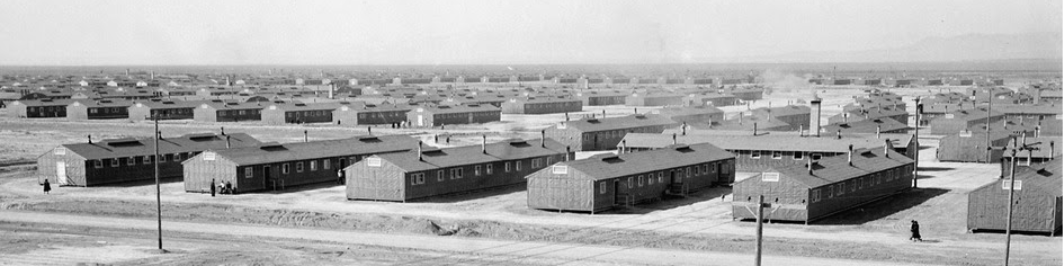
About the contributor: Iso Minamoto Umeki was born in Oakland, CA in May 1919, the third of five children. Her parents operated a laundry business, but later moved to San Leandro to open a general store. The family was incarcerated at Tanforan Race Track and then transferred to Topaz Concentration Camp in 1942. Iso married Kaoru Umeki in the dining hall at the Topaz Camp in 1942. After being released, she and Kaoru briefly lived in Salt Lake City, UT, where their first son Bryan was born, and then returned to California and raised their three children in Berkeley. Iso worked as a secretary for the Berkeley School District for 32 years until she retired at age 70. Her husband Kaoru worked for his uncle’s nursery in Union City until he died at age 59. Iso passed away in 1996 in Berkeley, CA.
Excerpted with edits from Iso Umeki’s memoir, written in 1968 and 1970. © 1970, Iso Umeki. All rights reserved.