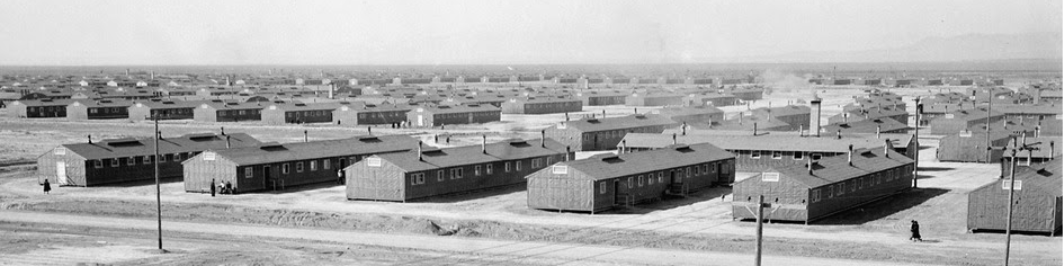
I celebrated my 10th birthday in the Grandstand at Tanforan Racetrack. Of course, it wasn’t a racetrack any more, but a detention camp for Japanese Americans. Instead of horses, families lived in the stables and newly built barracks.
Before the War, my family lived on Geary St. in Japantown in San Francisco. My father, Takeo Saito, worked as a dishwasher in a restaurant on Market St. My mother, Kikue, was a housewife. I was the eldest child; after me came Jane, Toru, Walter, and Ben, who was born in March 1942.


I remember the Nankaiya (a hotel), Benkyodo (a mochi and manju shop), a tofu-ya, and other businesses near our home. After Executive Order 9066 came out, Benkyodo gave away big cans of sembei (rice crackers) for free in preparation for closing and being taken away to Tanforan. It was a real treat because our family couldn’t afford to buy it usually. They also stored some of our things in the Benkyodo warehouse; but when we returned after the War, everything had been stolen.
All I remember about being taken away was that I wasn’t able to carry anything because I held a sibling in each hand.
I was born in Topaz, raised in Japantown, San Francisco, at 1661 Post Street. I remember the tofu, the manju, and the sembei shops, all in walking distance. Little by little I’ve learned about our history–and since uniting around the Wakasa Memorial Stone, discovered at Topaz by archaeologists Mary Farrell and Jeff Burton, I learned that the teacher, Mrs. Honderick, was married to the man who smuggled the movie camera into camp for Dave Tatsuno. She was an artist, and friend, who made many drawings of daily life in the barracks.
I’m glad May’s story evoked those memories for you, Masako! For those interested in Ella Honderich’s story and Topaz sketches, see our Topaz story “The Lost Sketches of Topaz” by Cynthia Wright.