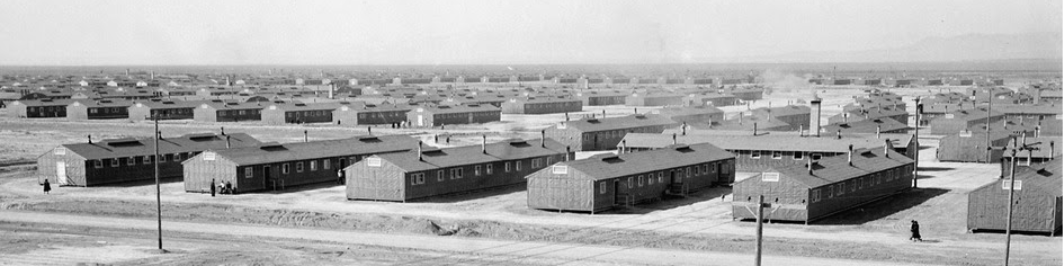
When we first arrived in Topaz, barracks were still being constructed, and there was nothing; but by the time we left in 1945, Topaz had been transformed by the hard work of the Japanese prisoners and had become “home.” It was pretty–there were gardens and trellises that the Issei had created, and a large pond in the middle of the camp. I didn’t want to leave. For my younger siblings, Topaz was the only home they had ever known.

I was born in Topaz, raised in Japantown, San Francisco, at 1661 Post Street. I remember the tofu, the manju, and the sembei shops, all in walking distance. Little by little I’ve learned about our history–and since uniting around the Wakasa Memorial Stone, discovered at Topaz by archaeologists Mary Farrell and Jeff Burton, I learned that the teacher, Mrs. Honderick, was married to the man who smuggled the movie camera into camp for Dave Tatsuno. She was an artist, and friend, who made many drawings of daily life in the barracks.
I’m glad May’s story evoked those memories for you, Masako! For those interested in Ella Honderich’s story and Topaz sketches, see our Topaz story “The Lost Sketches of Topaz” by Cynthia Wright.